For decades, Kenyan entrepreneurs have struggled to access financing because banks mainly recognized physical collateral like land, buildings, or machinery.
That reality is shifting.
Recently, Equity Group signaled a major change in how the financial sector views creators, founders, and digital businesses. Intellectual property, digital footprints, and creative output are now being recognized as economic assets — assets that can unlock capital.
What many entrepreneurs don’t realize is that Kenya’s legal system is already prepared for this transition. Under the Movable Property Security Rights (MPSR) framework, intellectual property can be used within secured financing structures.
Under this framework, a wide range of IP assets qualify:
Trademark
Copyright
Brand name
Software
Content
Designs
These are not just creative expressions. They are commercial assets that can support investment, partnerships, and even financing.
But there’s one critical condition: Your IP must be properly registered. Without registration, proving ownership, enforcing rights, or assigning commercial value becomes significantly harder.
As Kenya’s digital economy accelerates, intellectual property will become one of the most valuable assets a business can own. The founders who move early to secure their IP will be better positioned for:
Investment
Licensing
Expansion
Partnerships
Financing
In today’s economy, protecting your IP is not optional , it’s strategic.
Because your ideas are more than inspiration — they’re assets.
Platforms like KIRA are built specifically to help Kenyan startups, creators, and businesses register and protect their:
Every founder has asked this question at some point:
“What if I pitch my idea to an investor, partner, or corporate — and they build it without me?”
It is one of the biggest fears for entrepreneurs, innovators, and creators in Kenya. The good news is that there are practical legal steps you can take to reduce that risk.
The important legal reality, however, is this:
The law does not protect ideas in the abstract. It protects what you create, document, and can prove you own.
This article explains what Kenyan law protects, what it does not, and how to prepare before sharing your concept with anyone.
Why Founders Worry About Idea Theft
When you pitch, you may reveal:
A new business model
Software concepts
Product designs
Market strategies
Proprietary processes
Financial projections
If that information is valuable, you want to ensure it cannot be used without your permission.
Many founders assume that because they thought of the idea first, they automatically own it. That is not always true.
A Famous Kenyan Example: When a Pitch Leads to a Legal Dispute
One of Kenya’s best-known cases on this issue is:
Dedan Maina Warui & Chemibagmed Innovations Ltd v Safaricom PLC
A doctor developed a telemedicine concept and presented it to Safaricom under a confidentiality agreement. He later alleged that Safaricom launched a similar healthcare solution using his idea.
The dispute highlighted an important principle:
Ideas alone are not protected by copyright.
The court recognised that written materials may be protected, but proving that another party unlawfully copied protected expression — rather than independently developing a similar concept — can be challenging.
The lesson is clear: founders need more than an idea. They need evidence, documentation, and legal structure.
What the Law in Kenya Protects
Copyright protects:
→ Software code
→ Designs
→ Written documents
→ Pitch decks
→ Technical specifications
→ Marketing content
Trademarks protect:
→ Brand names
→ Logos
→ Taglines
Patents & Utility Models protect:
→ New inventions
→ Technical innovations
→ Functional products and processes
Confidential Information:
→ NDAs can protect information shared in confidence
Copyright protects the expression of an idea, not the underlying concept itself.
What the Law Does Not Automatically Protect
The following, by themselves, are generally not protected:
“I want to build an app for farmers.”
“I have an idea for a health platform.”
“I want to create an AI tool for lawyers.”
These are concepts, not protected legal assets. Protection increases when those concepts are turned into detailed and original work.
10 Practical Steps to Protect Your Idea Before You Pitch
1. Document the Idea Thoroughly
Create detailed written records:
Concept notes
Product specifications
Wireframes and process diagrams
Business plans
Technical architecture
The more concrete your work, the stronger your position.
2. Establish a Clear Creation Timeline
Keep records showing when the work was created:
Drafts and email threads
Meeting notes
Version histories
Cloud timestamps
These records can help prove ownership.
3. Register Copyright
Register key materials such as:
Software
Manuals and designs
Presentations
Registration strengthens your evidence of ownership.
4. Evaluate Patent or Utility Model Protection
If your innovation solves a technical problem, consider filing before broad disclosure. This is especially relevant for devices, manufacturing methods, engineering solutions, and technical systems.
5. Register Your Trademark Early
Secure your brand name and logo before launching publicly. This prevents others from registering a similar mark first.
6. Use a Non-Disclosure Agreement (NDA)
An NDA should:
Define confidential information clearly
Limit use to evaluation only
Prohibit unauthorised disclosure
Require return or deletion of materials
NDAs are most effective when the disclosed information is clearly identified and documented.
7. Share Information Gradually
In early conversations, disclose only the problem you solve, your market opportunity, and the high-level concept. Share sensitive technical details only when necessary.
8. Mark Documents as Confidential
Confidential and Proprietary – Not for Use or Disclosure Without Written Consent
This helps show the recipient was aware of confidentiality.
9. Use Written Communication
Send follow-up emails summarising what was shared, the purpose of disclosure, and confidentiality expectations. Written records are valuable evidence.
10. Ensure Your Company Owns the IP
If employees or freelancers helped create the product, use agreements assigning all intellectual property rights to your company. Without proper assignments, ownership may be disputed.
Do You Always Need an NDA?
Not necessarily. Professional investors often decline to sign NDAs because they review many similar ideas.
In these situations:
Limit disclosure
Focus on business potential rather than sensitive details
Ensure your IP is documented and protected before the meeting
Common Mistakes Founders Make
Pitching before documenting ownership
Assuming ideas are automatically protected
Relying solely on an NDA
Failing to register trademarks
Not assigning IP from contractors
Revealing technical details too early
Founder Protection Checklist
Before pitching, confirm that you have:
☐ Documented the idea in writing
☐ Registered or prepared key IP filings
☐ Signed NDAs where appropriate
☐ Marked materials as confidential
☐ Retained version histories and records
☐ Used assignment agreements with contributors
☐ Limited disclosure to what is necessary
What Investors and Partners Want to See
Serious investors are reassured when a startup has:
Clear ownership of code and content
Registered or pending trademarks
Confidentiality procedures
Contractor IP assignments
Patent filings where relevant
Good IP hygiene increases credibility and enterprise value.
Final Takeaway
The best way to protect your idea is not to keep it secret forever. It is to:
Turn it into documented assets
Register the rights that apply
Use confidentiality agreements
Keep evidence
Pitch strategically
An idea alone is difficult to enforce. A well-documented and legally protected innovation is a valuable business asset.
What the Law in Kenya Protects
Copyright protects:
→ Software code
→ Designs
→ Written documents
→ Pitch decks
→ Technical specifications
→ Marketing content
Trademarks protect:
→ Brand names
→ Logos
→ Taglines
Patents & Utility Models protect:
→ New inventions
→ Technical innovations
→ Functional products and processes
Confidential Information:
→ NDAs can protect information shared in confidence
Copyright protects the expression of an idea, not the underlying concept itself.
This article is for general information only and does not constitute legal advice. Specific advice should be obtained based on your circumstances.
Software is often the most valuable asset a technology business owns. Whether you are building a SaaS platform, mobile app, AI solution, fintech product, or internal business system, your software can represent years of development, significant investment, and a major competitive advantage. A common question for founders and developers in Kenya is:
How do I legally protect my software from copying, misuse, or ownership disputes?
The short answer is that software can be protected through a combination of:
Copyright
Contracts
Trademarks
Patents or utility models in limited cases
Confidentiality measures
Strong ownership documentation
Why Software Protection Matters
Without proper legal protection, a company may face:
Unauthorised copying of source code
Disputes with developers or freelancers
Brand imitation
Loss of investor confidence
Difficulties during due diligence
Reduced company valuation
Investors and acquirers routinely ask who owns the software and whether that ownership is properly documented.
What Parts of Software Can Be Protected?
A software business may have several protectable assets:
Asset
Potential Protection
Source code
Copyright
Object code
Copyright
Databases
Copyright and contractual protection
UI designs
Copyright
Documentation
Copyright
Brand name and logo
Trademark
Technical inventions
Patent or utility model (where applicable)
Algorithms and know-how
Confidentiality and trade secret protection
1. Copyright Protection for Software
In Kenya, computer programs are generally treated as literary works for copyright purposes.
Copyright protects:
Source code
Object code
Database structures
Technical documentation
User manuals
Design elements with sufficient originality
What Copyright Protects
Copyright prevents unauthorised copying, distribution, and adaptation of your code.
What Copyright Does Not Protect
Copyright does not protect general ideas, functional concepts, business models, or high-level features.
Two developers can independently create similar software without infringing copyright if they do not copy protected expression.
2. Copyright Registration
Although copyright arises automatically when original code is created, registration provides stronger evidence of ownership.
Registration can be useful when:
Enforcing rights
Licensing software
Raising investment
Conducting due diligence
Materials commonly registered include:
Source code excerpts
Manuals
Architecture documentation
3. Ownership: The Most Important Issue
Many software disputes concern ownership rather than infringement. Ensure every contributor — employee, freelancer, or co-founder — has the right agreements in place.
Employees Employment contracts should clearly state that software created within the scope of employment belongs to the company.
Freelancers & Agencies Independent contractors usually retain ownership unless they sign a written IP assignment agreement.
Co-Founders Founders should assign all software-related IP to the company at incorporation.
4. Confidentiality and Trade Secrets
Not every valuable aspect of software is suitable for registration. Trade secrets can be just as valuable as registered rights.
Trade secrets can include:
Algorithms
Training data
Product roadmaps
Infrastructure configurations
Internal methodologies
Protect them using:
NDAs
Restricted access and security controls
Confidentiality notices
5. Trademark Protection
Register your product name, company name, logo, and tagline. Trademark registration helps prevent competitors from adopting confusingly similar brands and strengthens your market position.
6. Can Software Be Patented?
Pure software is not automatically patentable. However, patent or utility model protection may be available when software forms part of a technical solution to a technical problem.
Examples may include:
Industrial control systems
Embedded technologies
Specialised technical processes
Patentability depends on the facts and should be assessed case by case.
7. Licensing Agreements
When you commercialise software, use written agreements addressing:
Scope of use
Subscription terms and restrictions
Ownership
Maintenance
Warranties and liability
Proper licensing converts software into a scalable, revenue-generating asset.
8. Open Source Compliance
If your product uses open source components, ensure compliance with applicable licences. Poor compliance can create legal and commercial issues during fundraising or acquisition.
Maintain:
A software bill of materials
Licence records
Internal approval procedures
9. Technical Security Measures
Legal protection should be supported by practical controls:
Access management
Version control
Backups
Audit logs
Encryption
These measures help prove ownership and reduce misuse.
10. Enforcement Options
If your software is copied or misused, possible responses include:
Cease and desist letters
Negotiation
Licensing discussions
Takedown requests
Civil litigation
Remedies may include injunctions, damages, and delivery up of infringing materials, depending on the circumstances.
Software Protection Checklist
Before launch, ensure that you have:
☐ Employment agreements with IP clauses
☐ Contractor assignment agreements
☐ Founder assignments to the company
☐ NDAs with all parties handling confidential information
☐ Copyright registration where appropriate
☐ Trademark registration
☐ Written licence agreements
☐ Open source compliance procedures
☐ Security controls and audit trails
What Investors Look For
During due diligence, investors often ask:
Who owns the source code?
Have all contributors assigned their rights?
Are trademarks registered?
Are there patent opportunities?
Are open source obligations managed?
Clean ownership and documentation materially improve fundraising readiness.
Common Mistakes
Paying developers without IP assignment agreements
Assuming ownership transfers automatically
Ignoring trademark registration
Disclosing confidential algorithms too broadly
Using open source software without licence compliance
Waiting until fundraising to resolve ownership issues
Example Scenario
A startup hires a freelance developer to build its platform but signs no assignment agreement.
Unless ownership is properly transferred in writing, the developer may retain rights in the code — creating major issues when investors conduct due diligence.
This is one of the most common and costly legal mistakes for technology companies.
Final Takeaway
The strongest way to protect software in Kenya is to combine:
Copyright
Clear ownership agreements
Confidentiality controls
Trademark registration
Patent analysis where relevant
Robust licensing documentation
Technology companies that put these protections in place early are better positioned to enforce their rights, attract investment, and scale confidently.
Need Help Protecting Your Idea?
Kira helps founders, creators, and businesses in Kenya with:
· NDAs ·
· Trademark registration ·
· Copyright registration ·
· Patent and utility model filings ·
· IP ownership audits ·
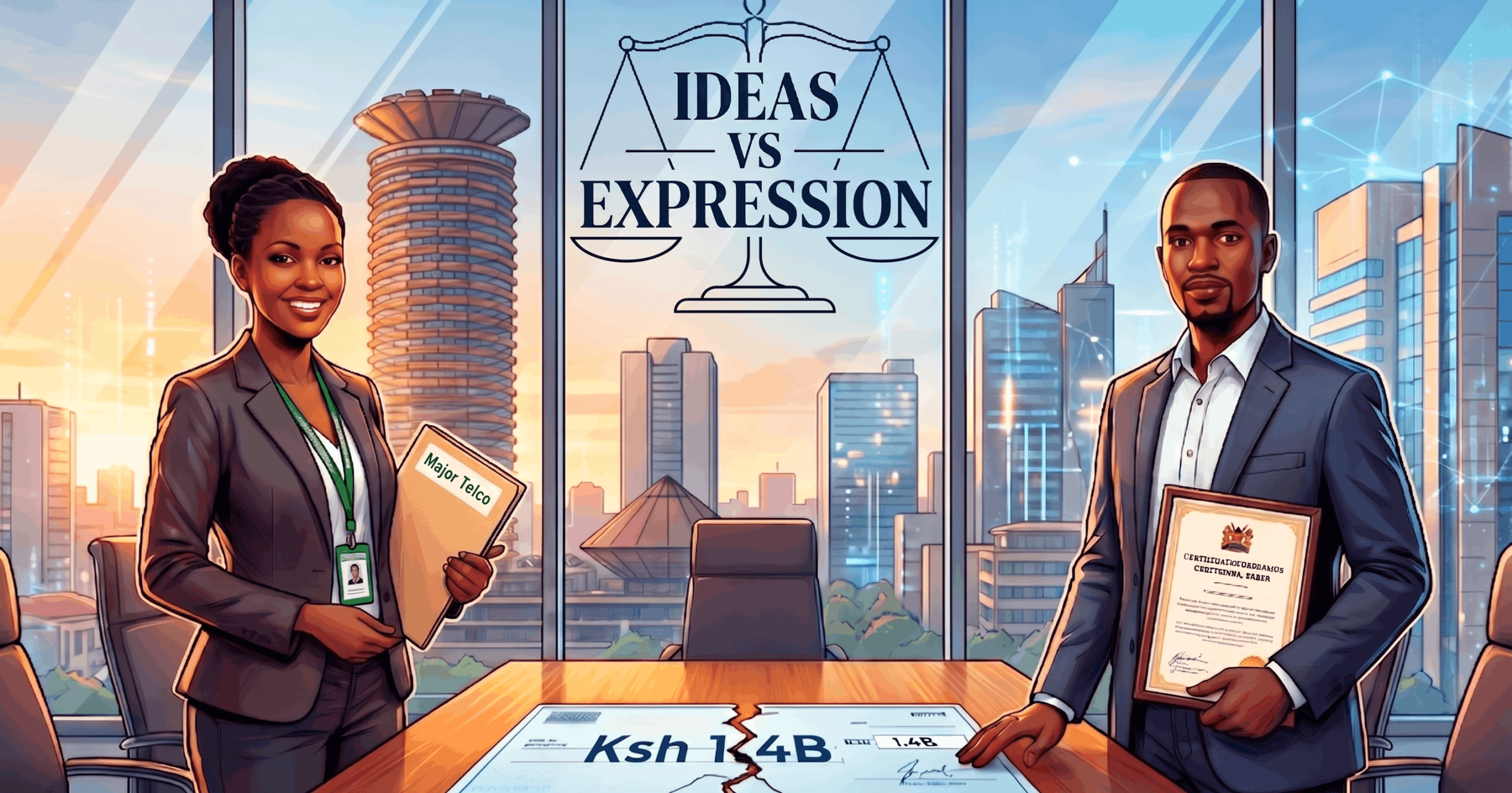
The High Court handed a Kenyan innovator a Ksh 1.4 billion win against Safaricom. The Court of Appeal may have other ideas.
In May 2026, the Milimani High Court delivered what looked like a watershed moment for Kenyan innovators. Peter Nthei Muoki and his company Beluga Ltd walked away with a Ksh 1.4 billion judgment against Safaricom, plus 0.5% of M-Pesa’s gross annual revenue for as long as Safaricom runs its “Manage Child Account” product. The judge even declined to shut the product down — citing disruption to millions of users — which tells you just how embedded in Kenyan life this thing already is.
“A landmark ruling — but one with serious legal vulnerabilities that Safaricom’s appeal will exploit.”
The backstory is one many entrepreneurs will recognise. In early 2021, Muoki pitched Safaricom on his “M-Teen Account” an M-Pesa sub-wallet for teenagers and young adults, designed to give parents visibility and control over their children’s spending. Safaricom told him it was too complicated to build. Eighteen months later, Safaricom launched something called “Manage Child Account.” Muoki sued.
The court found his concept which he had documented and registered with the Kenya Copyright Board , qualified as a literary work protected under copyright law. Noble ruling. Important precedent. And yet, as a practitioner, I have a nagging feeling the Court of Appeal will find significant room to manoeuvre.
Here is the legal elephant in the room.
Copyright law, in Kenya and globally has one foundational rule: it protects the expression of an idea, not the idea itself. You can copyright a song, a book, a screenplay. You cannot copyright the concept of “a love song” or “a thriller set in Nairobi.” The same applies here. A documented concept for a teen mobile wallet is an idea. The specific lines of code, the UI flow, the technical architecture , those are expression. The ruling does not clearly establish which of those was copied, and that distinction is everything on appeal.
What the Court of Appeal will scrutinise
Ideas vs. expression. Copyright protects documented expression, not the concept itself. Safaricom’s appeal will argue the court protected an idea — and it has a point.
Originality. Parental controls on financial products exist in multiple markets globally. Did Muoki’s documented concept meet the originality threshold? The ruling doesn’t fully interrogate this.
Substantial similarity. Infringement requires showing the defendant’s actual product substantially reproduced the protected work. The analysis of what exactly was copied, code, specs, flows is thin in the reported reasoning.
What the court got right. Access was established Muoki pitched to Safaricom directly. And dismissing the “verbal CBK instruction” defence was commercially astute. No serious company builds regulated financial products on an undocumented verbal nudge.
None of this means Muoki was wrong to sue. It means the legal path to keeping that Ksh 1.4 billion is steeper than the headline suggests.
Now for the bigger conversation.
Muoki’s case is not unique. Across Kenya, entrepreneurs pitch ideas to large corporates every day in boardrooms, over email, at demo days with no NDA, no registered IP, and no paper trail beyond goodwill. The power imbalance is stark. Corporates have legal teams. Founders have enthusiasm. When those pitches resurface later in a press release under a different name, most innovators have no recourse at all.
PROTECT YOURSELF BEFORE THE PITCH Register your IP before walking into any corporate meeting. A registered copyright creates a timestamped, enforceable record that changes everything if things go wrong. Visit kira.co.ke to get started.
The Muoki case, win or lose on appeal, has done something valuable: it put IP theft on Kenya’s corporate agenda in a way that a dozen policy papers never did. Safaricom is appealing. The outcome will shape how Kenyan courts handle the line between inspiration and infringement for years to come.
Full Case reference:
Muoki & another v Safaricom PLC; Huawei Technologies (Kenya) Company Ltd (Interested Party) (Civil Suit E407 of 2022) [2023] KEHC 22039 (KLR) (Commercial and Tax) (4 September 2023)